
How to Check Criminal History in Lancaster
Lancaster has a unusually clear city records route because the Bureau of Police publishes its own Records Unit products. Start there for a report or bureau-only history. Use the Unified Judicial System portal for the case path, and use county custody tools only when a booking or current detention question is involved. These sources overlap, but none is a duplicate of another.
- Identify whether the Lancaster City Bureau of Police handled the event and note the incident number, date, location, and requested product.
- Use the police Records Unit for an incident, accident, verification letter, good-conduct letter, or local record product that fits its rules.
- Search UJS in the Magisterial District and Common Pleas court categories to follow charges and the court outcome.
- Check Lancaster County Prison only for current county custody, then follow a state transfer through PA DOC if needed.
- Use PATCH for Pennsylvania repository information rather than treating a Lancaster police product as statewide coverage.
Save the report number and court docket number as separate identifiers. A Lancaster police file may name the originating court, while the docket can name the arresting agency and link the MDJ stage to Common Pleas.
Lancaster Police Records Counter
The Lancaster City Police Records Unit is on the third floor at 39 West Chestnut Street. It is open from 8 a.m. to 4 p.m. on weekdays, and its direct line is 717-735-6670. Visitors sign in at the front desk, receive a badge, and take the lobby elevator to the third floor. A current valid ID is required. If the address on the ID is old, the published FAQ says a current billing envelope can support the current address.
The official Records Unit screen shows the local products and request route available to Lancaster residents.
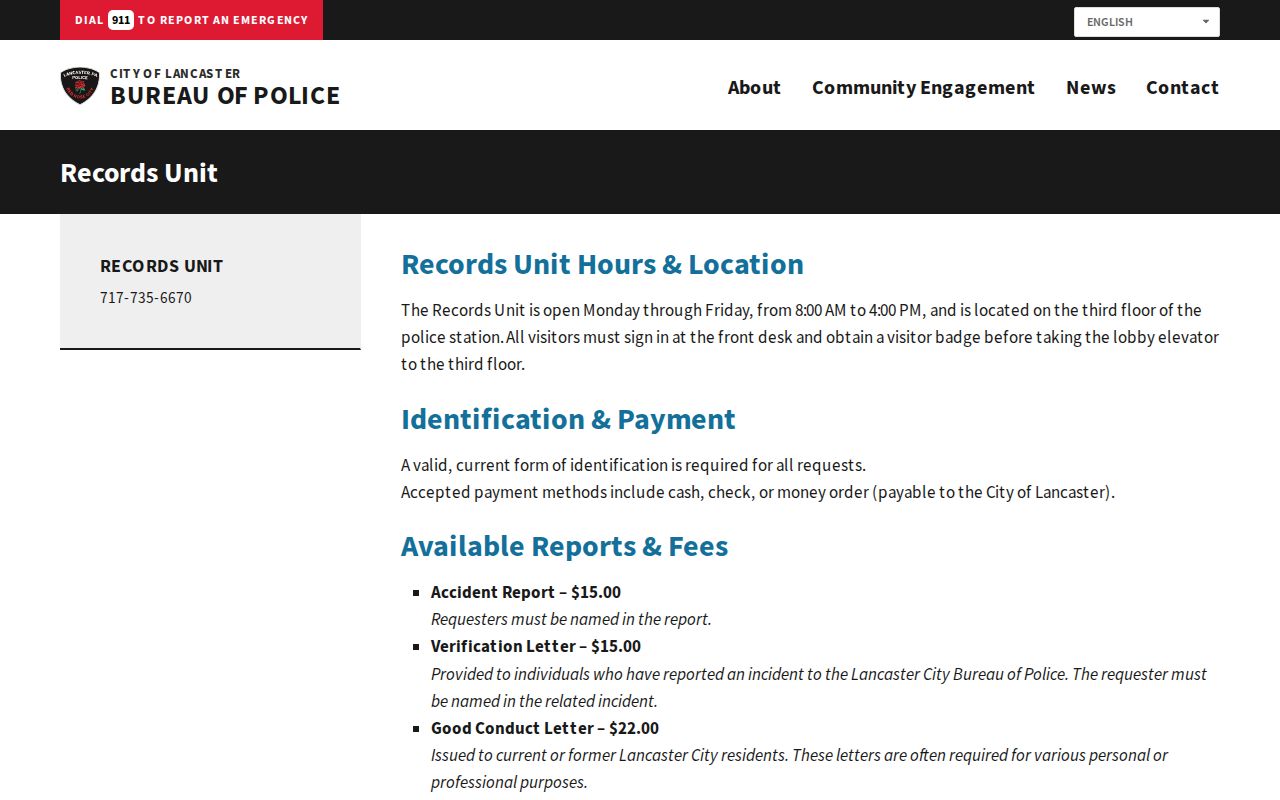
Those posted rules are specific to the city bureau and should not be applied to another Lancaster County police agency.
Cash is accepted only in person. Checks or money orders must be payable to the City of Lancaster. When a report is still under review, the unit cannot promise immediate release. A requester may ask for a call or, after prepayment, delivery by email or mail once approval occurs.
The Lancaster Police Department
The Lancaster City Bureau of Police creates the incident and arrest narrative for events its officers handle. That file can include the date and place, officers, the reported facts, initial offenses, and evidence references. Investigative details, victim-sensitive facts, juvenile material, and private identifiers may be withheld or redacted. A call for service does not by itself mean an arrest occurred.
The bureau's official site provides current police contact and transparency information for Lancaster records.
The city police source is the place to verify the agency's current form and counter rules before submitting a request.
Do not use the general police contact form to report an incident or request an officer. The bureau directs emergencies to 911 and nonemergency dispatch to 717-664-1180. The administration number is 717-735-3300. These channels serve different needs from the Records Unit line.
Lancaster Police Record Products
Lancaster publishes four well-defined products. An accident report costs $15, and the requester must be named in it. A verification letter costs $15 and is for a person who reported or was named in the incident. A good-conduct letter costs $22 for current or former residents. The $22 Local Background Check applies to someone with prior Lancaster police contact and can include incident or arrest dates, charges, and disposition.
| Lancaster product | Fee | Local scope or rule |
|---|---|---|
| Accident report | $15 | Requester must be named in the report |
| Verification letter | $15 | For a person who reported or was named in the event |
| Good-conduct letter | $22 | For a current or former Lancaster resident |
| Local background check | $22 | Limited to contact with the Lancaster City Bureau of Police |
The mail form covers accident reports and verification letters, not every investigative record. Include payment and a stamped, self-addressed envelope. Approved records may be picked up, mailed, or emailed after prepayment. PATCH is the separate state repository product and has broader Pennsylvania scope.
Arrests and Bookings in Lancaster
A Lancaster arrest can create several records at once. City police create the arrest report. A Magisterial District Judge records the preliminary arraignment and bail. If the person is committed, Lancaster County Prison creates the booking and custody entry. Fingerprints from a qualifying arrest begin the Pennsylvania State Police repository cycle. Each system answers a different question.
Lancaster does not publish a verified city jail roster or comprehensive daily booking blotter. The county Public Records hub links to the current Lancaster Prison search. It is a custody snapshot, not a historical arrest index. A missing result may reflect release, transfer, spelling variation, or movement to another system. The full local custody discussion belongs with the Lancaster County arrest history channels.
Booking charges remain provisional. They may be amended, withdrawn, dismissed, or replaced when the District Attorney files the Common Pleas information. Always read the court charge-level disposition before describing an outcome.
When a Lancaster Report Is Pending
A routine request can stall when the wrong form is used. Lancaster's mail form is restricted to accident reports and verification letters. It is not a catchall form for an arrest narrative, video, or any other investigative file. A report that remains under internal review also may not be ready when the requester first contacts the counter.
Ask the Records Unit whether the desired product is available, whether identification or other proof is required, and whether a redacted releasable version can be supplied. Provide the incident number, event date and place, involved role, exact record requested, preferred delivery method, and whether certification is truly needed. These details help staff locate the correct Lancaster file without a broad request.
Note: An approved Lancaster police report can be sent after prepayment, but a pending review has no guaranteed same-day release.
Lancaster Municipal Court Records
Lancaster has no separate city municipal criminal court. Pennsylvania uses Magisterial District Courts for local summary matters, preliminary arraignments, bail, and preliminary hearings. A misdemeanor or felony held for court moves to the Lancaster County Court of Common Pleas. This distinction prevents searches for a city court database that does not exist.
| Court Name | The assigned Magisterial District Court, followed by Lancaster County Court of Common Pleas when charges are held for court |
|---|---|
| Case Types Heard | MDJ summary, traffic, nontraffic, preliminary criminal, bail, and hearing matters; Common Pleas misdemeanor and felony prosecutions |
| Case Lookup Channel | Free Unified Judicial System Public Web Docket Sheets, searched in both MDJ and Common Pleas categories |
| What the Docket Shows | Complaint, bail, hearing result, charges, events, disposition, sentence, costs, and public case status as applicable |
| Copies & Fees | Public web docket sheets are free; ask the relevant court or Clerk to confirm document and certification charges |
Use participant name plus Lancaster County and minimal criteria first. Then open the PDF and record the originating MDJ number. The Lancaster County criminal court case record route explains the later Common Pleas file and Clerk fallback in depth.
Lancaster Court Record Bridge
A Lancaster case may have two docket numbers. The MDJ docket preserves the early complaint, preliminary arraignment, bail, and preliminary-hearing result. When charges are held for court, a Common Pleas docket becomes the main prosecution record. Searching just one level can hide either the early context or the final plea, trial, disposition, and sentence.
The UJS Public Web Docket Sheets search is the official bridge between those levels. Search the participant in Lancaster County under each relevant court type. Confirm the arresting agency, filing date, charge sequence, and originating docket before treating two results as the same case. The public PDF summarizes docket activity but does not attach every pleading or order.
The Lancaster City search route stays local at the start, yet the court custodian is county or judicial rather than the police Records Unit. For missing public attachments or certified Common Pleas documents, contact the Clerk of Courts instead of filing a city request.
Where Lancaster Records End Up
A Lancaster event moves through custodians rather than into one master city file. Police retain the report. The assigned MDJ records the first court stage. Common Pleas and the Clerk maintain the later prosecution file. Courts and agencies report qualifying dispositions to the Pennsylvania State Police Central Repository.
Record flow: Lancaster City Bureau of Police › Lancaster County Courts › Pennsylvania State Police Central Repository
The Lancaster County District Attorney handles the prosecution after a matter reaches Common Pleas. Its official office page provides current program and contact information.
The Lancaster County District Attorney page illustrates the county prosecution stage that follows the local police and MDJ work.
This county handoff is why a Lancaster police report alone cannot establish the final court result.
Three Lancaster Record Custodians
Downtown Lancaster has three different open-record routes. The city officer handles formal municipal requests through the Lancaster public-records portal and can be reached at 717-291-3556. The Lancaster County Open Records Officer works at 150 North Queen Street for county administrative records. The judicial Rule 509 officer handles court financial records. None replaces ordinary UJS or Clerk access to a criminal docket.
| Custodian | Best Lancaster use | Not a substitute for |
|---|---|---|
| City open-record officer | Formal city administrative record requests | County, prison, or court files |
| County open-record officer | County administrative records | Lancaster police investigative files |
| Judicial Rule 509 officer | Judicial financial records | Routine criminal docket access |
For a police report, begin with the city Records Unit. For a docket, begin with UJS. This simple split avoids sending a valid Lancaster request to an office that does not hold the record.
Lancaster Criminal Record Context
Lancaster is the county seat and the only incorporated city in Lancaster County. The city, courthouse, Government Center, probation office, police headquarters, and county prison form a dense records corridor. The Census estimated Lancaster's July 1, 2025 population at 58,366. That figure describes the city, not the whole county, and should not be paired with countywide crime totals.
The Census QuickFacts profile for Lancaster supplies the official city population context.
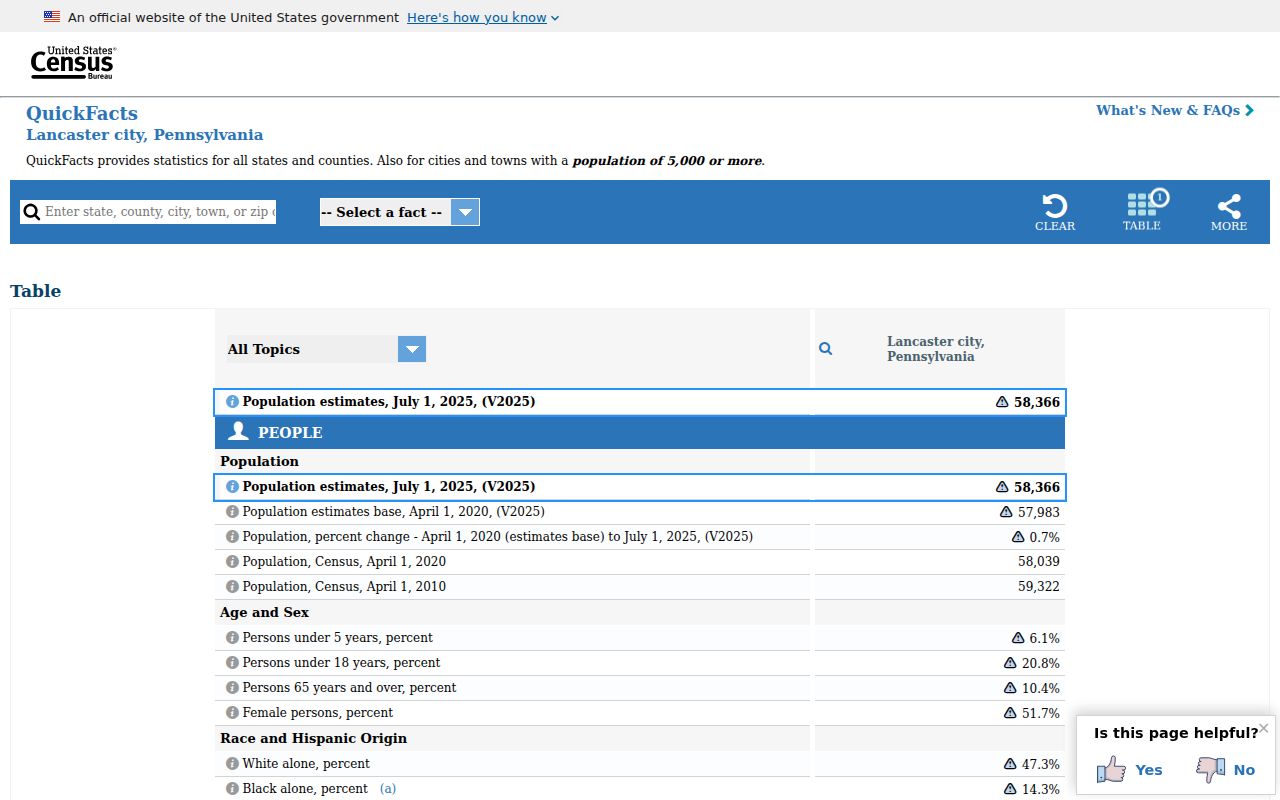
City scale matters because Lancaster police records cover the bureau's jurisdiction, not every borough and township in the county.
Crime claims also require a city agency and a stated year. The Pennsylvania UCR dashboard allows a Lancaster Police filter rather than blending local and county coverage. Read each result by measure and reporting agency so offense counts, arrest counts, and clearances are not confused. Record the year, extraction date, measure, and Lancaster Police filter with any figure. Reporting coverage can change over time. A city result should not be compared with a Lancaster County total unless the population and agency scope are stated with care.
Public Access Rules
The Pennsylvania Right-to-Know Law governs qualifying city agency records, but it does not force release of all investigative information, victim-sensitive facts, juvenile records, or protected personal identifiers. Judicial case access follows the Unified Judicial System Public Access Policy. Pennsylvania criminal history dissemination law separately controls what compiled history may be released.
Key Statutes:
Pennsylvania Right-to-Know Law presumes qualifying agency records are open while preserving statutory exemptions.
18 Pa.C.S. § 9121 controls dissemination of criminal history and blocks public release of limited-access charges.
UJS Public Access Policy governs remote docket publication, confidential information, and access to Pennsylvania court case records.
Ask for a separable, redacted version when only part of a Lancaster record is restricted. A missing online docket may reflect sealing, expungement, limited access, a juvenile matter, or a search mismatch. It does not prove that the underlying event never existed.